Candida Höfer
Rehearsing Assembly
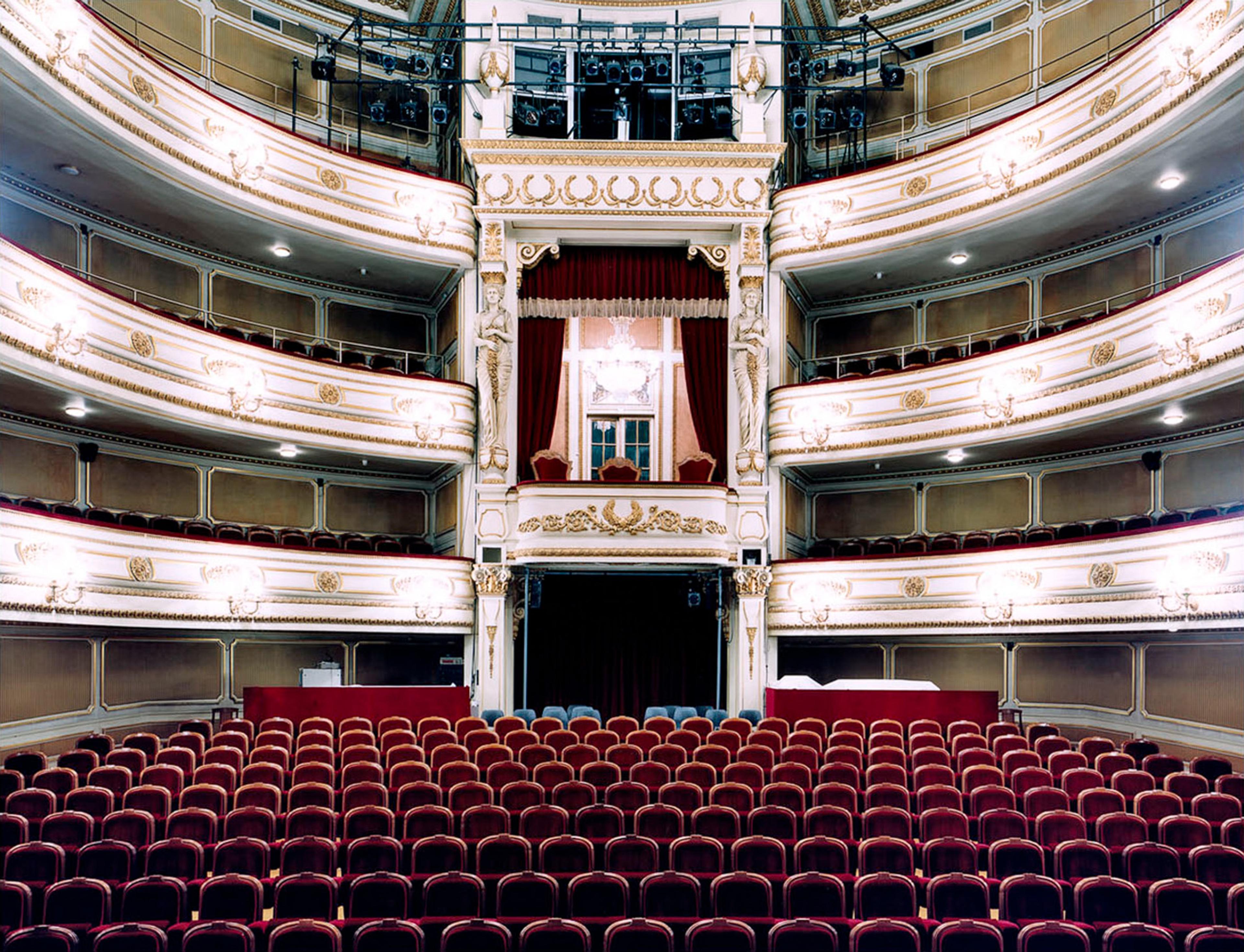
From empty libraries to theatres before the curtain rises, the exhibition considers how public spaces rehearse the ways we live together.
ABOUT THE EXHIBITION
From 30 October 2026, Fotografiska Shanghai presents Rehearsing Assembly, a major solo exhibition by German photographer Candida Höfer. A prominent figure in the Düsseldorf School of Photography, Höfer is internationally known for her large-scale photographs of public interiors, including theatres, libraries, museums and archives. Curated by Shen Chen, the exhibition brings together 28 colour photographs spanning key periods of Höfer’s practice from the 1990s to the present, offering an overview of her sustained engagement with space, visual order and public life.
A Key Figure of the Düsseldorf School, Developing a Language of “Portraits of Space”
Born in Eberswalde, Germany, in 1944, Candida Höfer entered the Kunstakademie Düsseldorf in 1973 to study film before turning to photography. From 1976 to 1982, she studied with Bernd Becher and Hilla Becher, alongside a generation of artists that included Andreas Gursky, Thomas Ruff and Thomas Struth, who would become central figures of the Düsseldorf School of Photography.
Höfer initially focused on people, photographing the everyday lives of Turkish immigrant families in shops, homes and public spaces. She later turned her attention to interiors after people had left. Through frontal viewpoints, balanced compositions, large-format photography and restrained colour, she brought the scale, order and traces of use within architecture to the centre of the image. Rather than treating these photographs as straightforward architectural documentation, Höfer has described them as “portraits of space.”
In 2024, Höfer received the Käthe Kollwitz Prize from the Akademie der Künste in Berlin. Karin Sander, Chair of the Visual Arts Section of the Akademie der Künste and a member of the prize jury, described Höfer’s work as giving the public and semi-public spaces around us “an almost spiritual quality,” strengthened by the presence of those who are absent.
Rehearsing Assembly: Space Begins Before the Crowd Arrives
The concept of Rehearsing Assembly emerges from curator Shen Chen’s reconsideration of Höfer’s long-term practice. In 2015, Shen co-curated Höfer’s solo exhibition On Method at Three Shadows Photography Art Centre in Beijing with Herbert Burkert. For the present exhibition, he returns to the public spaces that have remained central to Höfer’s work, bringing together five recurring threads: the rehearsal of display, looking, reading, ceremony and modern public life. Different types of spaces are placed in dialogue, allowing their shared structures and functions to come into view.
The word “assembly” carries two meanings. It refers both to the gathering of people and to the process through which separate elements are organised and brought together as a whole. Höfer’s photographs operate between these two senses. Seats, bookshelves, display cases, stairways, lighting, foyers and architectural axes first assemble a room into a space designed for use. Once in place, that arrangement begins to organise those who enter it: where they stand, which direction they face, where their gaze is drawn, how their bodies move through the space, and which bodies may have been excluded from the routes it imagines.
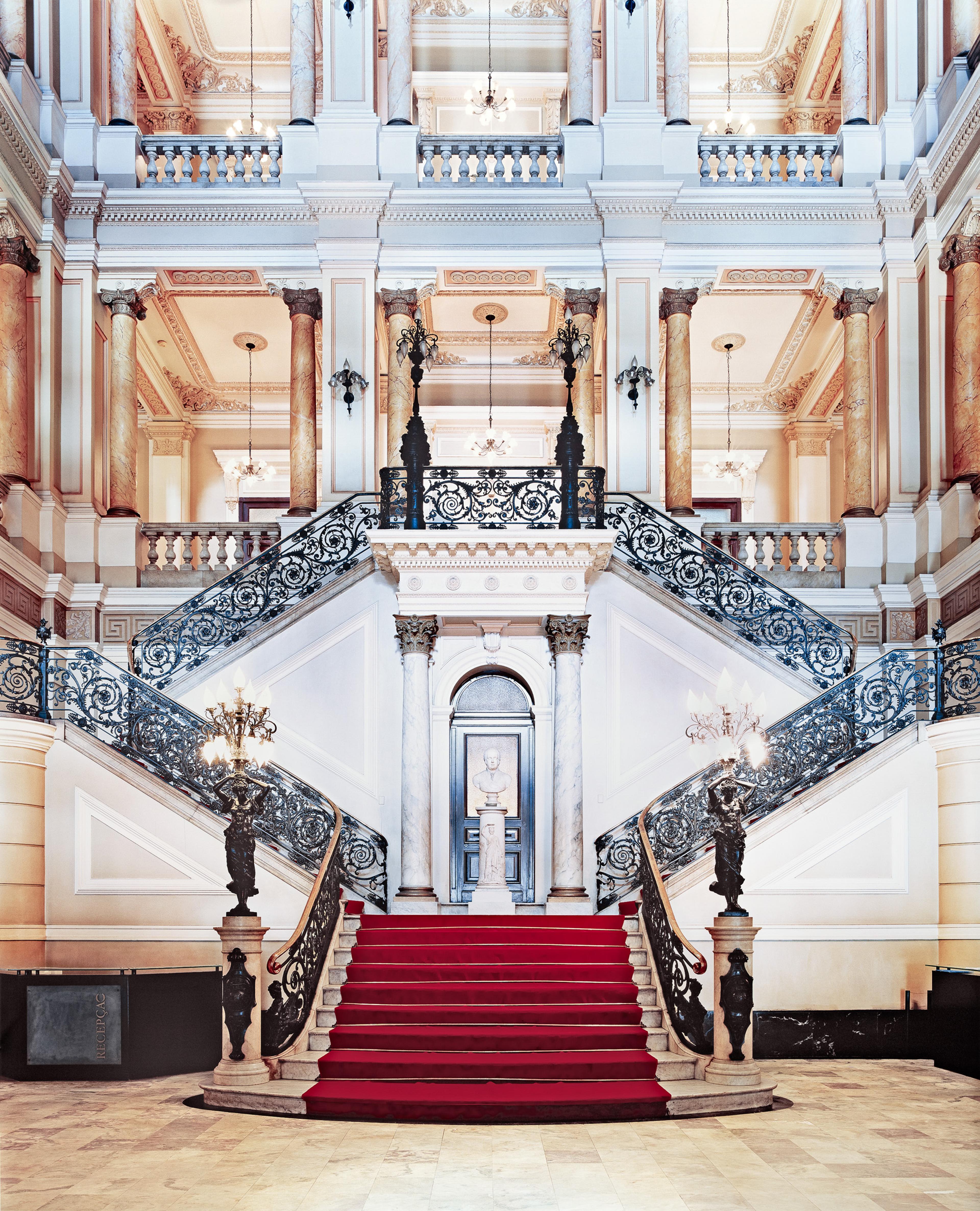
What Höfer photographs, then, is not simply an empty room waiting for an assembly to begin. It is a space in which assembly is already being rehearsed. A theatre’s seating organises the act of looking; a library’s classification system orders knowledge; a museum’s display cases establish relationships between people and history. Before a space is occupied, its architecture and systems have already begun to shape how people enter, remain, look and move.
The rehearsal also takes place within the camera itself. Höfer’s apparently neutral viewpoint establishes a particular position from which the space is to be seen. The camera becomes the last seat in the room: before the shutter is released, it has already determined where to look from and at what distance. When viewers stand before Höfer’s large-scale photographs, their own distance from the image, the angle at which they look and the time they spend looking quietly restage the position once occupied by the camera.
Viewing therefore takes place not only within the spaces Höfer photographs, but also in the exhibition space and through the bodies of the viewers themselves.
From Libraries to Theatres: A Genealogy of Public Space
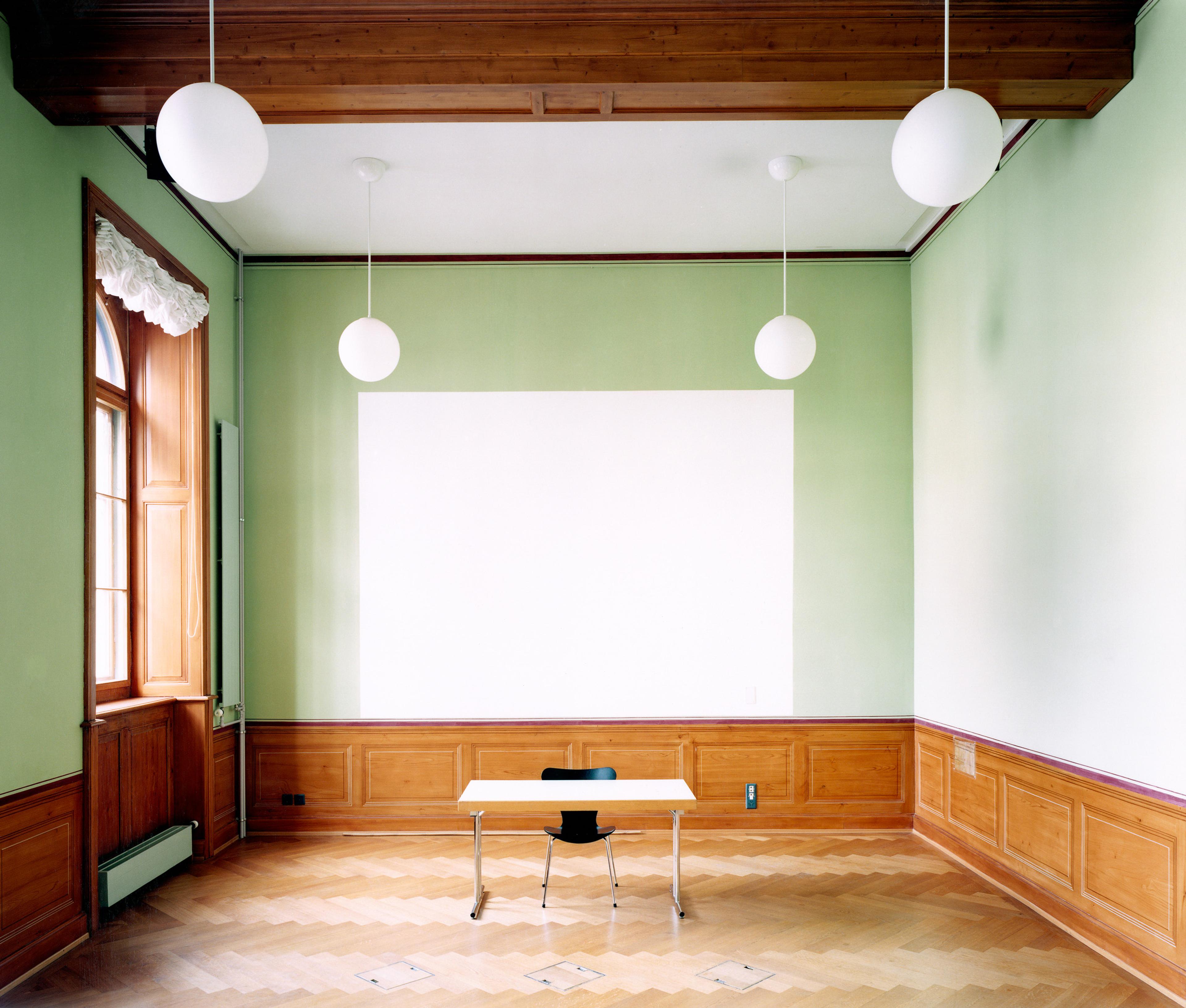
The works in Rehearsing Assembly span the years 1997 to 2023 and encompass libraries, museums, archives, historic buildings, shelters and theatres. Coming from different historical periods and shaped by different forms of use, they form part of a sustained visual exploration of public space that has developed across Höfer’s practice over several decades.
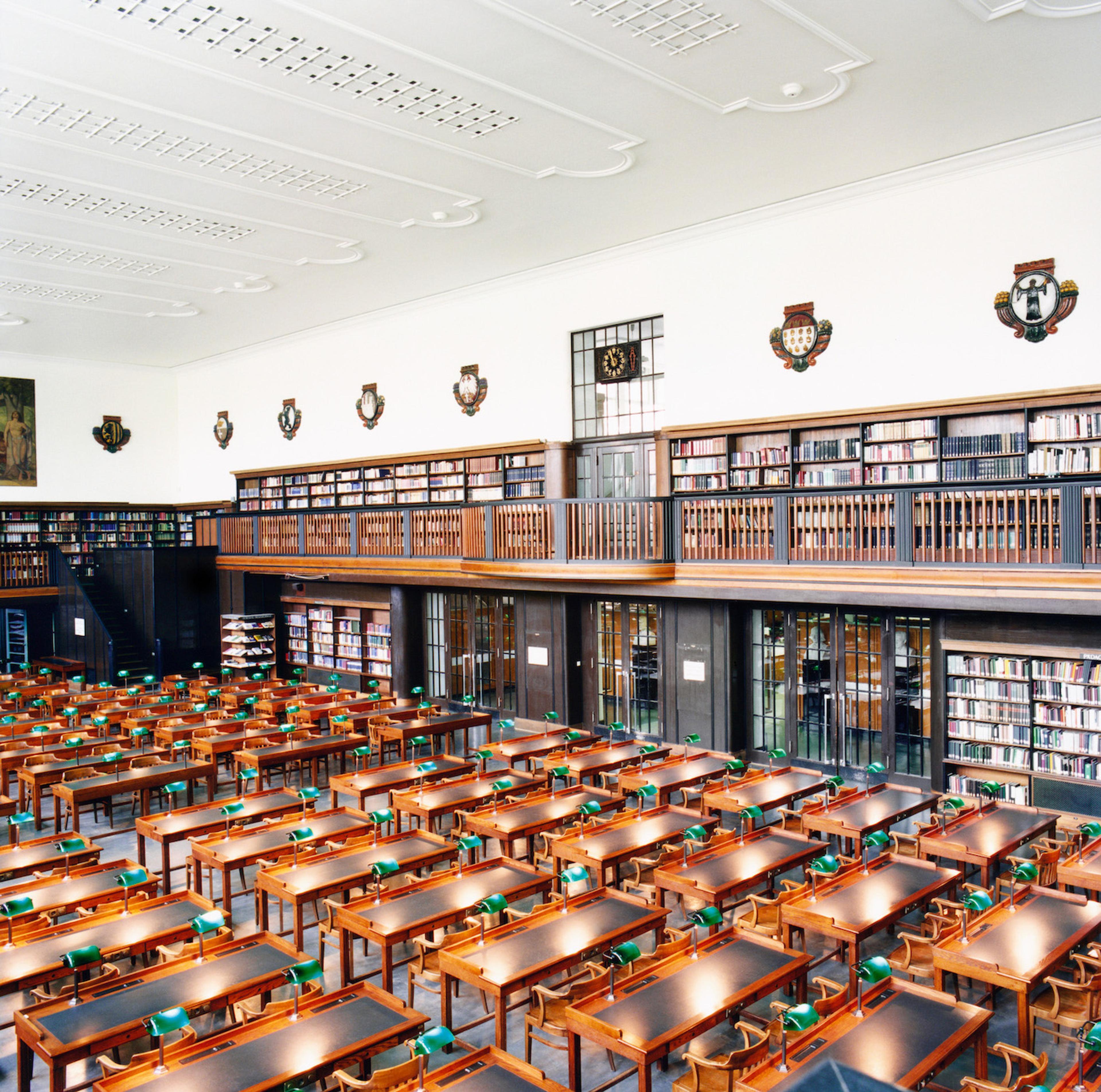
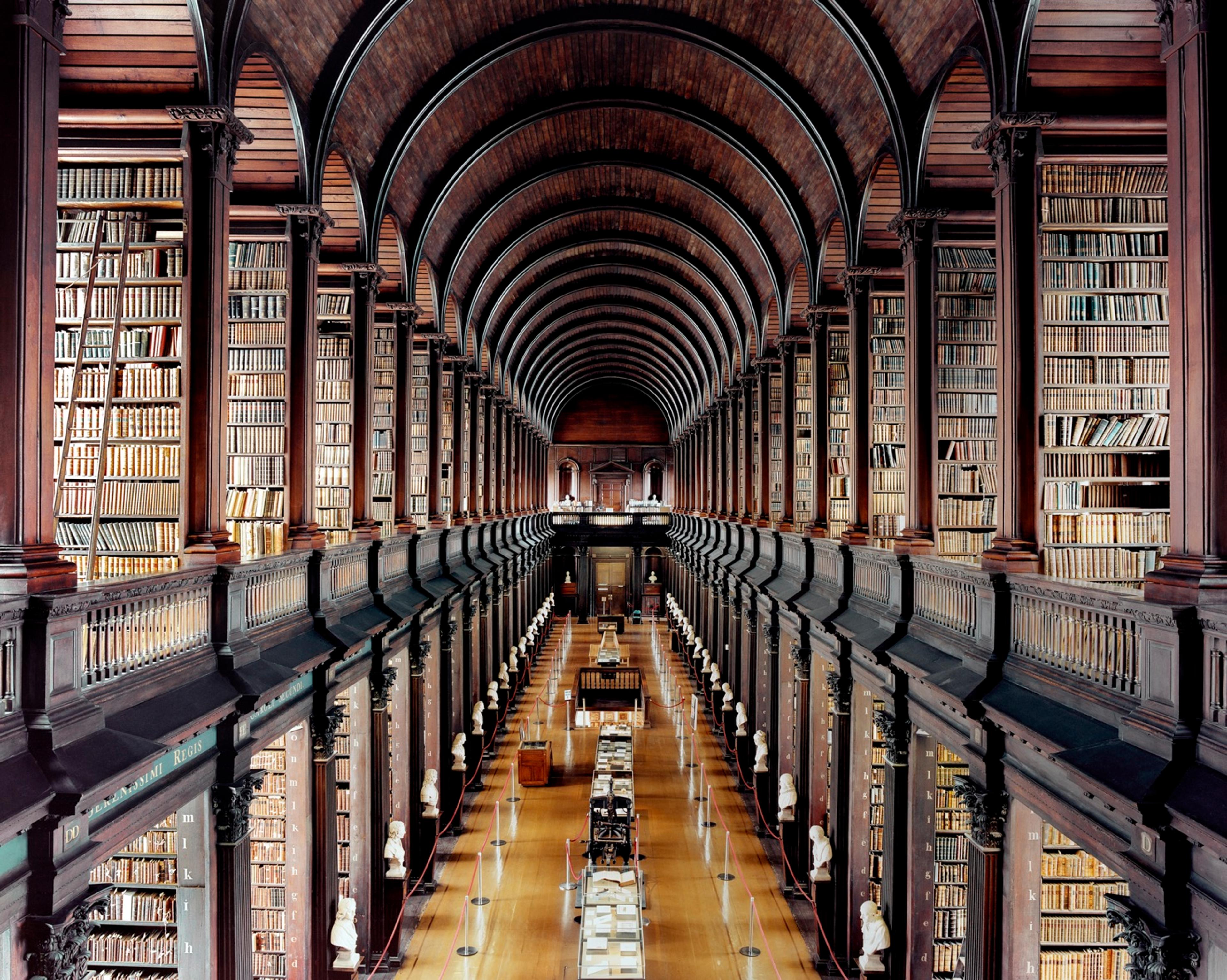
Deutsche Bücherei Leipzig XI 1997 and Trinity College Library Dublin I 2004 both focus on library interiors. The former is structured by rows of bookshelves, tables and architectural axes, while the latter brings the viewer into the Long Room of Trinity College Library in Dublin, where wooden shelving, architectural structure and natural light create a strong sense of depth.
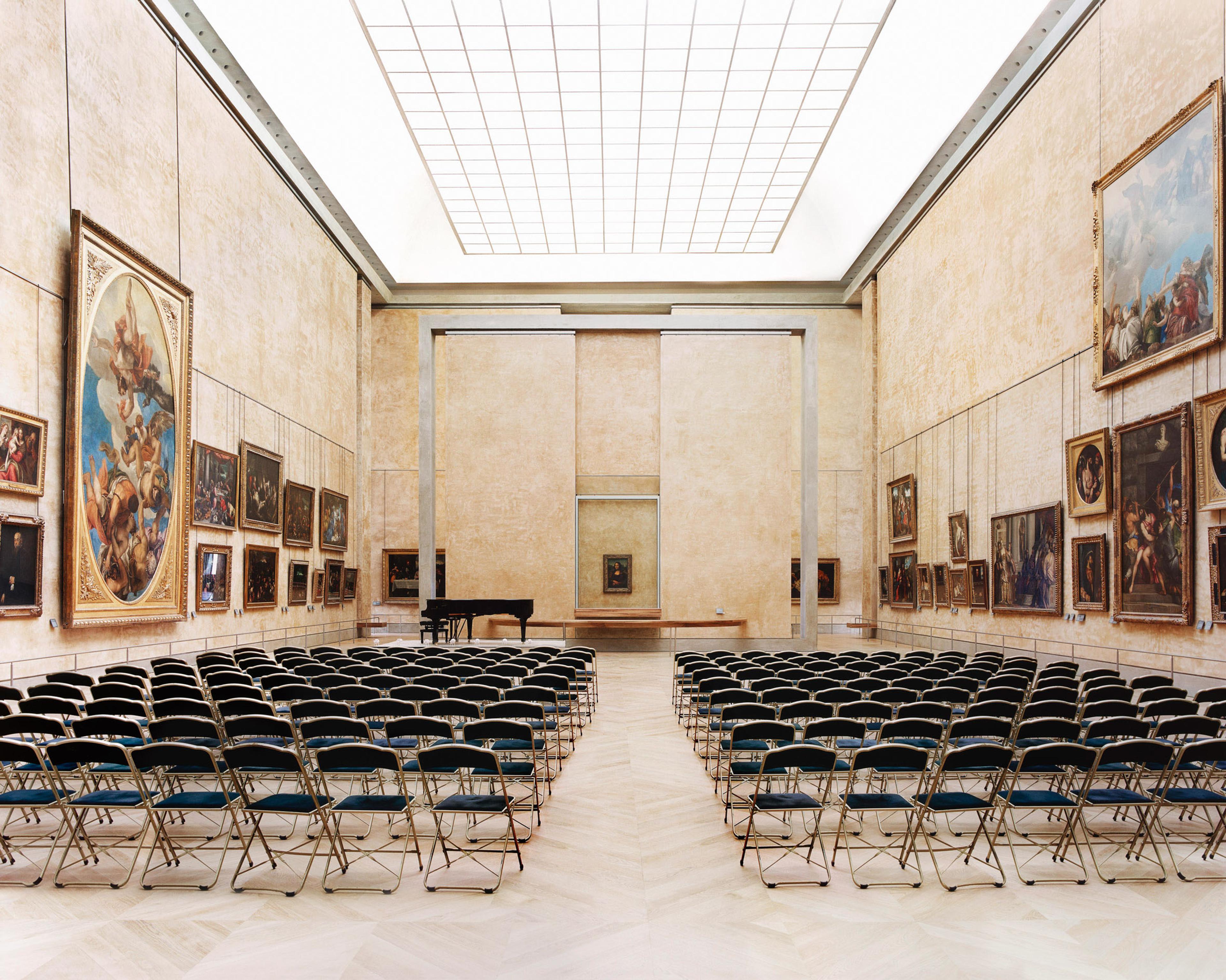
Höfer also turns her camera towards major historic buildings and cultural institutions. Musée du Louvre Paris III 2005 belongs to the series she produced on commission for the Louvre, bringing architecture, display and scale within the museum into a single image. Neues Museum Berlin LXI 2009 presents the restored interior of the museum, where traces of wartime damage coexist with contemporary restoration. Archivo General de Indias Sevilla IV 2010 depicts an archival storage space, where rows of cabinets and archive boxes create a continuous visual rhythm.
Across different cultural and architectural contexts, Höfer has continued to extend this approach. Li Yuan Library Beijing III 2014, photographed in Huairou, Beijing, presents the interior and exterior of the Li Yuan Library designed by architect Li Xiaodong. Cité Refuge de l'Armée du Salut
[Le Corbusier - ©FLC/ADAGP]Paris II 2018 records the building designed by Le Corbusier, where geometric structures and seating form the principal elements of the composition.
The most recent work in the exhibition, Semper Oper Dresden V 2023, is also among its largest. Nearly three metres wide, the photograph brings the stage, orchestra pit and auditorium into a single field of vision. Even without an audience, the architecture of the theatre as a site of collective viewing remains clearly legible.
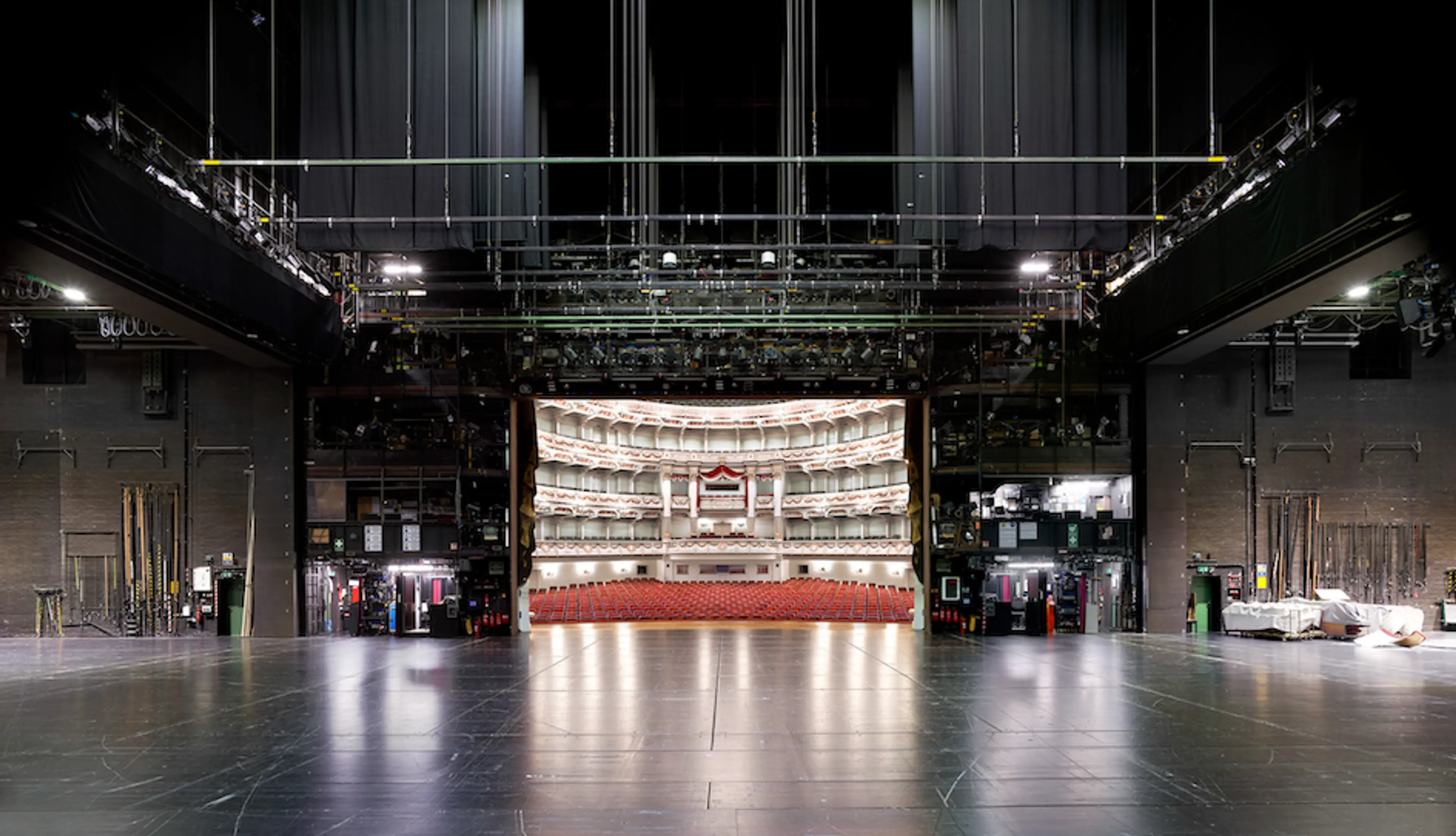
From reading in libraries to preservation in archives and collective viewing in theatres, Höfer has consistently approached public architecture as a way of observing collective behaviour and spatial order. Over five decades, her practice has contributed to a broader understanding of how contemporary photography can examine space, institutions and the mechanisms of looking.
One of Höfer’s most comprehensive solo exhibitions in China in recent years, Rehearsing Assembly brings together her sustained and rigorous examination of public architecture while inviting audiences to reconsider the structures that shape everyday and shared life. As people temporarily disappear from view, architecture, order and accumulated history come to the foreground. Her precise and restrained photographs reveal the systems that quietly organise how we inhabit, move through and look at the world around us.
People out, space in. Höfer’s photographs present a world that is familiar yet subtly estranged. From 30 October 2026, visitors to Fotografiska Shanghai are invited to look again at the public spaces that have become part of everyday life.
ABOUT ARTIST
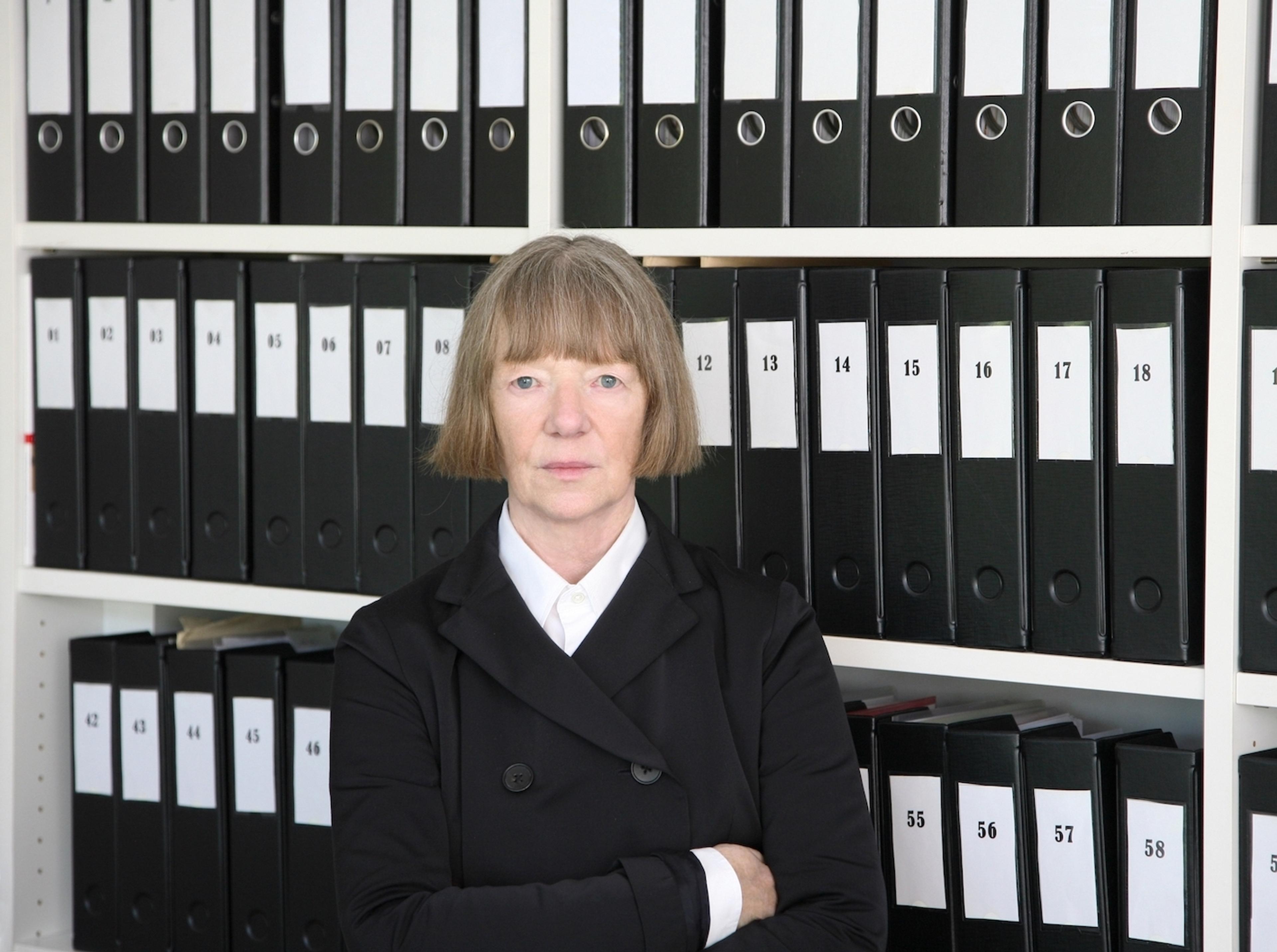
Candida Höfer was born in Eberswalde in 1944.
From 1963 to 1964 she was a trainee at the Photo Studio Schmölz-Huth in Cologne. From 1964 to 1968 Candida studied at the Kölner Werkschulen (School for Arts and Crafts). From 1968 to 1970 she was working as an independent photographer for various newspapers and magazines. In 1970, she moved to Hamburg where she was an assistant at the Photo Studio Werner Bokelberg with the main task of constructing images using the daguerreotype technique. In 1972, Candida returned to Cologne to work at an art gallery.
In 1973, she was accepted at the Art Academy Düsseldorf where she first attended the film class of Ole John (Polvsen), the Danish cinematographer. With the arrival of Bernd Becher at the Academy she moved to his class as one of his first pupils; Candida left the Academy as a “Master Pupil” in 1982.
In 1975, Candida had her first exhibition at Konrad Fischer Galerie Emerging Artists Booth during Art Cologne. From 1997 to 2000 she was Professor of Photography at the Staatliche Hochschule für Gestaltung, Karlsruhe.
In 2002, Candida Höfer participated at documenta 11. In 2003 she represented Germany at the 50. Biennale de Venezia (together with the late Martin Kippenberger).
Her work is shown in museums such as the Kunsthalle Basel, the Kunsthalle Berne, the Portikus, Frankfurt am Main, the Museum of Modern Art, New York, the Power Plant, Toronto, the Kunsthaus Bregenz, the Reina Sofia, Madrid, and the Museum Ludwig, Cologne.
For her work Candida Höfer has received various prizes and distinctions such as in 1987 the “ars viva” Cultural Award of the Federation of German Industries, in 2000 the Order of Merit of the Federal Republic of Germany, in 2002 the Woman Art Award of the State of North-Rhine Westphalia, in 2007 the Finkenwerder Art Award, in 2015 the Cross of Merit 1st Class of the Federal Republic of Germany, in 2016 the Cologne Fine Art Prize, in 2018 the Sony World Photography Award and in 2022 the Lucie Award for Achievements in Architecture; in September 2024 she received the Käthe Kollwitz Award of the Academy of Fine Arts, Berlin, Germany.
The artist lives in Cologne.
ABOUT CURATOR
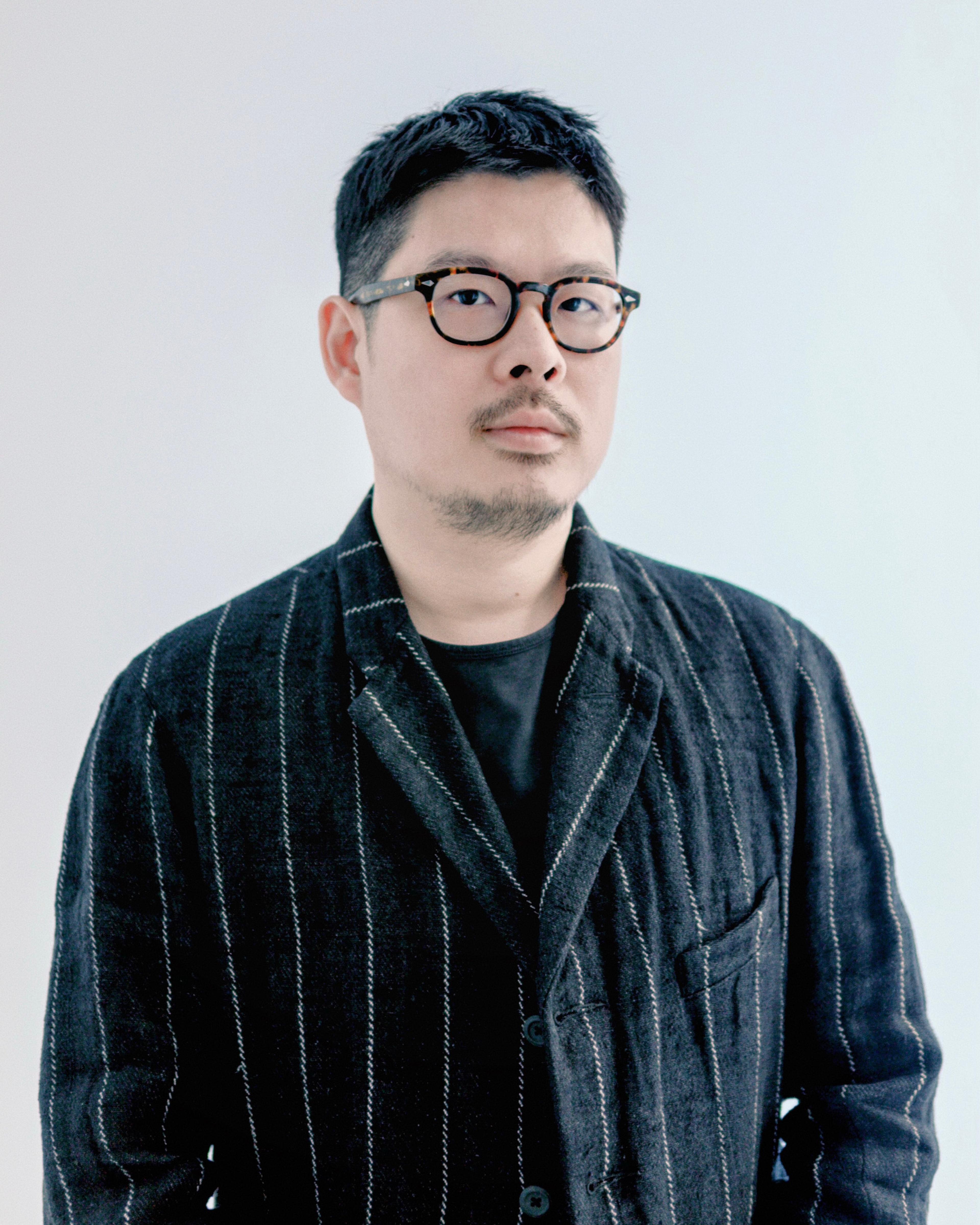
Shen Chen is an independent curator who lives and works in Beijing. He previously served as curator at White Space and Three Shadows Photography Art Centre. He graduated from Peking University, The Chinese University of Hong Kong, and Cranbrook Academy of Art, receiving a Bachelor of Laws in International Politics, a Master of Science in New Media, and a Master of Fine Arts in Photography.
Shen's curatorial practice examines how intellectual history, political history, and social structures continue to produce lived experience within contemporary life. For him, history is not a distant background, nor is experience merely a matter of personal feeling. The ways in which people understand their own situations, organize everyday experience, form beliefs, and make judgments are precisely where history and politics continue to take place. He has therefore long been concerned with conditions that remain difficult to fully name within formal systems of knowledge: bodily symptoms, rituals, collective memory, local knowledge, labor relations, structures of belief, and informal orders, as well as how they continue to shape people's understanding of themselves and the world. His curatorial work often begins from concrete sites of lived experience. Rather than treating art simply as a footnote to, or illustration of, historical, social, or theoretical issues, he approaches it as a way of reorganizing experience: bringing questions that have been compressed into concepts, institutions, or narratives back into perceptible realities of life, where they can once again be recognized, discussed, and reconsidered.
This line of inquiry runs through many of his projects: from Phantom Pain Clinic (2017, Jimei × Arles International Photo Festival, Xiamen), which examined bodily symptoms and social psychology, to Sunset on a Dead End: “The Notorious" and Their Inexplicable Modes of Existence (2019, Power Station of Art, Shanghai), which addressed stigma, disorder, and the predicament of subjectivity; and more recently to projects such as A Higher Calling (2021, White Space, Beijing), Li Liao: The Wife Went to Start a Business (2023, Pingshan Art Museum, Shenzhen), and Zhang Xiao: The Mortal Immortals (2025, A4 Art Museum, Chengdu), which engage with structures of belief, experiences of labor, and local knowledge.
In 2019, he received the Grand Award of the Emerging Curators Project at the Power Station of Art, Shanghai. In 2020, he received a fellowship from Pro Helvetia, the Swiss Arts Council, for a curatorial research residency, and in 2026, he was selected for the 2026-2028 De Ying Fellowship Programme. He has also been invited to nominate artists for international awards and programs including Italy's MAST Photography Grant, the Vontobel Contemporary Photography Prize, the Magnum Foundation's Abigail Cohen Fellowship, and the Jimei × Arles Discovery Award.